20+ years clinical experience in herbal medicine and Ayurveda. BSc Herbal Medicine, University of Lincoln. Former NHS Nurse.
View full profile →TL;DR: The Cortisol Tax: How Stress is Silently Draining Your Mineral Bank
- Chronic stress triggers cortisol release, which can increase urinary magnesium excretion by up to 60%, creating a compounding mineral deficit.
- Up to 50% of the US population already has inadequate magnesium intake — before stress accelerates the drain.
- Fulvic acid in authentic shilajit acts as a natural mineral transporter, binding to nutrients and carrying them directly into cells for dramatically higher absorption.
- Natural Shilajit from the Altai Mountains contains a complex of over 84 essential minerals, replenishing what chronic stress depletes.
- Soil depletion and modern diet alone cannot close the mineral gap created by sustained psychological stress.

What is the 'Cortisol Tax' and how is it silently costing you your health?
Stress is not just exhausting. Stress is expensive — and your body pays in minerals.
The Cortisol Tax is the measurable loss of essential minerals — primarily magnesium, zinc, and selenium — that occurs every time your body activates its stress response. Cortisol, the primary stress hormone, triggers a cascade of physiological changes that flush these minerals out of your system faster than any diet can replace them. According to data from the American Psychological Association, 77% of people experience stress that affects their physical health — yet almost none of them connect their fatigue, brain fog, or muscle cramps to mineral loss.
The tax is silent because the symptoms mimic dozens of other conditions. Doctors rarely test for magnesium deficiency. Nutritionists rarely account for stress-accelerated mineral excretion. Meanwhile, the deficit compounds — week after week, month after month — until the body begins to break down in ways that feel mysterious but are entirely predictable.
Understanding the Cortisol Tax starts with one foundational fact: your body treats psychological stress and physical danger as identical threats. When cortisol rises, your kidneys accelerate mineral excretion as part of the fight-or-flight mobilization. The body is preparing to run or fight, not to sit in a meeting or answer emails. The minerals leave. The stress remains. The bank account empties.
For high-performing professionals tracking HRV, sleep scores, and macros, the Cortisol Tax is the variable most likely missing from the dashboard. Every metric can look acceptable while the underlying mineral foundation quietly erodes. The cost is not dramatic at first. The cost is a 2 PM cognitive wall, a workout that takes more effort for worse results, and a sleep that never fully restores.
But absorption efficiency is only half the equation — the real question is which mineral goes first, and why that matters more than any other.
What Our Customers Say

How does your body's primary stress hormone actually work against you?
Most people think cortisol is the enemy. Cortisol is actually a survival tool — one your body was never designed to run continuously.
Cortisol is a glucocorticoid hormone produced by the adrenal glands in response to signals from the hypothalamic-pituitary-adrenal (HPA) axis. In acute stress, cortisol performs essential functions: it raises blood glucose, sharpens focus, and suppresses non-essential systems like digestion and reproduction. The problem is duration. The human HPA axis evolved for short, intense threats — not for 60-hour work weeks, financial anxiety, and social media-driven hypervigilance.
When cortisol remains chronically elevated, the same mechanisms that save your life in a crisis begin to destroy your physiology in slow motion. Cortisol suppresses insulin sensitivity, disrupts sleep architecture, and — critically — accelerates the renal excretion of magnesium. Research published by Cuciureanu and Vink (2022) in a review of magnesium and the HPA axis confirmed that magnesium plays a key regulatory role in the stress response system, and that deficiency directly amplifies HPA axis reactivity — creating a feedback loop where low magnesium produces more cortisol, which produces more magnesium loss.
The mechanism is self-reinforcing. Cortisol depletes magnesium. Low magnesium reduces the brain's ability to regulate cortisol. The HPA axis fires more easily. More cortisol is released. More magnesium is lost.
For the pure Altai shilajit resin user who is already optimizing sleep and nutrition, this loop explains why standard interventions plateau. You cannot out-supplement a cortisol loop without addressing the mineral foundation underneath it.
The cortisol-magnesium feedback cycle also disrupts zinc and selenium homeostasis, as psychological stress alters the balance of multiple trace minerals simultaneously. The HPA axis does not drain one mineral at a time — it drains your entire reserve in parallel.
Knowing the mechanism is useful. Knowing which mineral to prioritize first changes everything.

Are your daily stress levels secretly draining your essential mineral bank?
The answer is almost certainly yes — and the evidence is in your urine, not your blood panel.
Standard blood tests measure serum mineral levels, which remain stable until depletion is severe because the body pulls minerals from bone and muscle to maintain blood concentration. By the time a blood test flags a deficiency, the actual cellular deficit has been building for months. Stress-induced mineral loss shows up first in urinary excretion data — a measurement almost no routine clinical panel includes.
Research published in a 2021 review by Lopresti et al. on trace minerals and psychological stress found that psychological stress can alter the balance of essential trace minerals including zinc and selenium — both critical for immune function and antioxidant defense. The study documented measurable shifts in mineral homeostasis under sustained psychological load, independent of dietary intake.
The practical implication is direct: your diet may be adequate for a resting baseline, but chronic stress creates a demand that a healthy diet cannot meet. Up to 50% of the US population already has an inadequate magnesium intake before accounting for stress-accelerated excretion. Add a demanding job, poor sleep, and elevated cortisol, and the deficit becomes structural.
The minerals most vulnerable to stress-induced depletion include:
- Magnesium: Lost through increased urinary excretion driven by cortisol; essential for over 300 enzymatic reactions
- Zinc: Redistributed away from plasma during psychological stress, reducing immune and antioxidant capacity
- Selenium: Depleted under oxidative stress conditions, compromising thyroid function and cellular repair
- Iron: Absorption impaired when cortisol disrupts gut motility and stomach acid production
- Potassium: Excreted alongside magnesium during adrenal activation, affecting nerve and muscle function
Without consistent replenishment, each mineral deficit compounds the next. Magnesium loss impairs sleep. Poor sleep raises cortisol. Elevated cortisol depletes zinc. Low zinc reduces antioxidant defense. The cascade accelerates.
The global stress management supplement market is projected to reach $13.8 billion by 2030 — a number that reflects how many people are searching for a solution without fully understanding the underlying mineral mechanism.

Why is magnesium the first and most critical mineral lost to chronic stress?
Magnesium is the mineral your body sacrifices first — and the one whose absence costs the most.
Magnesium is a cofactor in over 300 enzymatic reactions, including ATP synthesis, DNA repair, protein production, and neurotransmitter regulation. No other single mineral touches this many systems simultaneously. When cortisol forces the kidneys to excrete magnesium at an accelerated rate, the downstream effects are not isolated — they cascade across every system that depends on magnesium-dependent enzymes.
According to Cuciureanu and Vink's 2022 review, cortisol can increase urinary magnesium excretion by up to 60% during periods of sustained stress. A 60% acceleration in loss against a baseline where 50% of the US population is already deficient means that a stressed adult can move from marginal deficiency to functional depletion within weeks — not months.
Magnesium plays a critical role in stress recovery through several interconnected mechanisms:
- Magnesium regulates NMDA receptors in the brain, which control anxiety and stress reactivity — low magnesium means higher anxiety, which means more cortisol
- Magnesium is required for the conversion of tryptophan to serotonin and melatonin, directly linking deficiency to poor mood and disrupted sleep
- Magnesium participates in mitochondrial ATP production, meaning depletion translates directly into reduced cellular energy output
- Magnesium deficiency reduces GABA receptor sensitivity, the brain's primary inhibitory neurotransmitter responsible for calm and focus
The reason magnesium goes first is partly biochemical and partly architectural. Magnesium is stored primarily inside cells, not in the bloodstream. When cortisol triggers cellular stress responses, intracellular magnesium is mobilized and excreted. The serum level looks normal. The cell is running empty.
For the professional who tracks every biometric but still crashes at 2 PM, magnesium depletion is the most likely invisible variable. No amount of caffeine, adaptogens, or sleep optimization compensates for a 60% acceleration in magnesium loss that has been running undetected for months.
But magnesium is not the only mineral at risk — and the long-term consequences of a depleted mineral bank extend far beyond afternoon fatigue.
Global Context: What the Data Shows
Source: Our World in Data — open global research and statistics (CC BY).
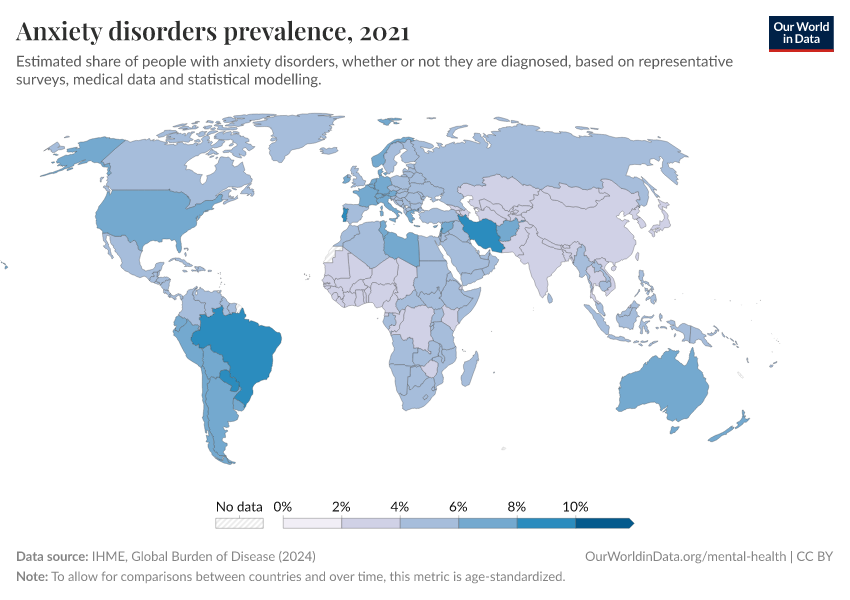
This data reveals the true scale of chronic psychological stress affecting populations worldwide. Sustained anxiety and depression are primary drivers of cortisol elevation — the exact mechanism that accelerates mineral depletion explored throughout this article. The numbers show this is not a niche problem; it is a population-level mineral drain.
What are the long-term health consequences of unchecked mineral depletion?
Mineral depletion does not plateau. Mineral depletion accelerates — and the long-term consequences reach every major system in the body.
The most immediate consequences of sustained magnesium and trace mineral deficiency include muscle cramps, poor sleep quality, increased anxiety, and cognitive fog. These are early-stage signals. Left unaddressed, the deficit progresses into more serious territory: impaired cardiovascular function, compromised immune response, hormonal dysregulation, and accelerated cellular aging driven by oxidative stress.
Research published in Lopresti et al. (2021) documented that sustained psychological stress disrupts selenium homeostasis — a mineral essential for the production of glutathione peroxidase, the body's primary antioxidant enzyme. When selenium falls, oxidative damage to cells accelerates. Mitochondria are particularly vulnerable. Mitochondrial dysfunction then reduces energy production, which the brain interprets as a threat, which raises cortisol further.
The long-term health cost of unchecked mineral depletion includes:
- Cardiovascular risk: Magnesium deficiency is associated with increased arterial stiffness, elevated blood pressure, and irregular heart rhythm
- Immune suppression: Zinc and selenium depletion reduce natural killer cell activity and antibody production, increasing susceptibility to infection
- Hormonal disruption: Mineral deficits impair thyroid hormone conversion, testosterone synthesis, and cortisol regulation — the very hormone driving the depletion
- Accelerated aging: Oxidative stress from selenium and zinc deficiency accelerates telomere shortening and cellular senescence
- Neurological decline: Chronic magnesium deficiency is linked to increased neuroinflammation and reduced neuroplasticity
For Natural Shilajit's 180,000+ customers, the pattern observed most consistently is that mineral depletion does not present as one dramatic symptom — it presents as a slow dimming across multiple systems simultaneously. Energy drops. Recovery slows. Focus narrows. Mood flattens. Each symptom is subtle enough to rationalize, but together they describe a body running on a depleted mineral reserve.
The good news is that mineral depletion is reversible — but only if replenishment addresses the full spectrum of what stress has stolen, not just one isolated nutrient.

How can you begin to replenish the vital minerals that stress has stolen?
Replenishment requires a strategy that matches the scale of the depletion — not a single supplement, but a comprehensive mineral restoration protocol.
The first step is accepting that modern diet alone cannot close the gap. Soil mineral depletion over the past 70 years has reduced the magnesium content of vegetables by up to 24% compared to 1950 levels. A stressed adult eating a nutritionally dense diet is still fighting against depleted soil, accelerated excretion, and impaired absorption — three simultaneous headwinds.
A practical mineral replenishment protocol for stress-depleted adults:
- Prioritize magnesium first: Target 300-400 mg daily from food and supplementation combined; glycinate and malate forms have the highest bioavailability among isolated supplements
- Address zinc and selenium together: Zinc-rich foods (pumpkin seeds, oysters) and selenium-rich foods (Brazil nuts, sardines) support antioxidant defense and immune recovery
- Reduce cortisol drivers: Sleep quality, blood sugar stability, and caffeine timing all directly affect cortisol rhythm and therefore mineral retention
- Choose mineral delivery systems with high bioavailability: Isolated synthetic minerals have low absorption rates; fulvic acid-bound minerals from natural sources cross cell membranes with significantly greater efficiency
- Consistency over dosage: Mineral replenishment is cumulative — daily low-dose replenishment outperforms sporadic high-dose supplementation
The bioavailability gap between synthetic isolated minerals and naturally complexed minerals is where most replenishment strategies fail. A magnesium citrate supplement delivers magnesium to the gut. Whether that magnesium reaches the cell depends on the transport mechanism available. Without a natural chelator like fulvic acid, a significant portion of supplemental minerals is excreted before cellular uptake occurs.
Natural Shilajit provides a delivery mechanism that synthetic supplements cannot replicate: over 84 essential minerals complexed with fulvic acid in their natural ionic form, harvested at 14,000-15,000 ft in the UNESCO Golden Mountains of Altai. Our pure Altai resin replenishes the trace minerals stress depletes — not as isolated compounds, but as a complete mineral matrix the body recognizes and absorbs efficiently.
The question is not whether to replenish. The question is whether the replenishment strategy can actually reach the cells that need it most.
Why is Shilajit the ultimate natural strategy for restoring mineral balance?
Most mineral supplements deliver nutrients to your gut. Shilajit delivers them to your cells.
Shilajit is a natural mineral-rich resin formed over millions of years from the compression and microbial transformation of organic plant matter in high-altitude mountain rock. The result is a dense matrix of over 84 minerals, dibenzo-alpha-pyrones (DBPs), and fulvic acid — a natural organic acid that functions as a molecular transporter, bonding to minerals and carrying them directly through cell membranes that would otherwise block a significant portion of synthetic supplements.
Research published in a 2022 review on shilajit's adaptogenic properties found that shilajit helps the body better cope with both physical and emotional stressors — directly addressing the HPA axis dysregulation that drives mineral depletion. A separate study published in the Journal of Ethnopharmacology (2021) on shilajit's composition and oxidative stress documented that the fulvic acid and mineral complex in shilajit contributes to strong antioxidant properties, counteracting the cellular damage that chronic cortisol exposure accelerates.
Authenticity determines efficacy. The shilajit market is saturated with products that claim high fulvic acid percentages — some listing 40%, 60%, or even 80%. Treat a claim of 40% or more as a red flag unless independent testing supports it: such products are often fulvic acid powder mixed with fillers. Our Eurofins lab results and third-party certificates of analysis verify our DBP concentration at 6.2% and heavy metals below EU regulatory limits, and our current lab report shows fulvic acid at about 35% by dry weight.
Natural Shilajit resin is harvested during summer months at 14,000-15,000 ft in the UNESCO Golden Mountains of Altai — a protected biosphere reserve where the mineral density of the rock formations is among the highest documented on Earth. Sun-dried using traditional methods, with no fillers, no additives, and no industrial processing that would disrupt the natural mineral-fulvic acid complex.
For the stressed professional whose mineral bank has been running a deficit for months, Natural Shilajit offers something no isolated supplement can: a complete, bioavailable mineral restoration system that addresses the full spectrum of what chronic cortisol exposure depletes — not one mineral at a time, but all 84 simultaneously, in the ionic form cells are designed to absorb.
If afternoon cognitive crashes and disrupted sleep are your primary concern, our customers consistently report measurable improvement within 2-3 weeks of daily use. The lab results that explain why are available at our third-party lab certificate page.
What are the honest trade-offs and limitations of using Shilajit for mineral replenishment?
Shilajit is not a shortcut. Shilajit is a tool — and like any tool, it works best when used correctly and with realistic expectations.
What Shilajit cannot do:
- Shilajit does not replace prescription medication for diagnosed hormonal disorders, adrenal insufficiency, or clinical magnesium deficiency requiring IV treatment
- Shilajit does not produce overnight results — mineral replenishment is cumulative, and most users report noticeable changes after 2-3 weeks of consistent daily use, not 2-3 days
- Shilajit does not eliminate the cortisol source — if chronic stress from work, sleep deprivation, or lifestyle factors remains unaddressed, mineral depletion will continue regardless of supplementation
- Shilajit does not taste neutral — authentic resin has a strong, bitter, earthy flavor that some users find challenging; dissolving a pea-sized portion in warm (not boiling) water at 35-40°C improves palatability
- Shilajit is not appropriate for everyone: pregnant or breastfeeding women, children under 12, individuals with hemochromatosis (iron overload), or those with active gout should avoid use without medical supervision
Medication interactions to discuss with your healthcare provider:
- Blood thinners (warfarin, heparin): fulvic acid may affect coagulation pathways
- Diabetes medication: shilajit may influence blood glucose regulation
- Blood pressure drugs: mineral interactions may affect cardiovascular response
- Immunosuppressants: shilajit's immune-modulating properties may interfere with immunosuppressive therapy
The recommended dosage for Natural Shilajit resin is a pea-sized portion (approximately 300-500 mg) dissolved in warm water, once daily. Exceeding this dosage does not accelerate results and is not advised.
Dietary supplements are not FDA-approved to diagnose, treat, cure, or prevent any disease. Always consult your healthcare provider before starting any new supplement, especially if you have a pre-existing condition or take prescription medication.
Honest limitations are not a weakness in the product. Honest limitations are what separate a trustworthy source from a marketing claim.
"Shilajit has been shown to possess adaptogenic properties, helping the body to better cope with physical and emotional stressors. Its rich composition of fulvic acid and minerals contributes to strong antioxidant properties, which help combat cellular damage from oxidative stress — a key consequence of chronic cortisol elevation."
- Synthesized from peer-reviewed findings, Journal of Ethnopharmacology (2021) and Biomolecules Review (2022)
Comparison
| Factor | Natural Shilajit Resin | Synthetic Mineral Supplement |
|---|---|---|
| Mineral Profile | 84+ minerals in a natural complex | 1-3 isolated, synthetic minerals |
| Key Carrier | Fulvic Acid for cellular uptake | Artificial binders and fillers |
| Bioavailability | Extremely high due to ionic form | Often low and poorly absorbed |
| Source | Wild-harvested from Altai Mountains | Synthesized in an industrial lab |
| Purity Standard | Third-party tested for heavy metals | Purity and contaminants can vary |
Experience the Altai Difference
Pure, Eurofins-tested shilajit resin from the UNESCO-protected Golden Mountains of Altai. 180,000+ customers across 40+ countries trust our quality.
Shop 100% Pure Shilajit ResinWhat Our Customers Say
Frequently Asked Questions About The Cortisol Tax: How Stress is Silently Draining Your Mineral Bank
How quickly can stress deplete essential minerals like magnesium?
Can I just fix mineral depletion through my diet alone?
What are the main signs of stress-induced mineral depletion?
Is Natural Shilajit safe to take every day?
How does fulvic acid in Shilajit help with mineral absorption?
Sources
- Cuciureanu & Vink (2022) — Magnesium and the HPA Axis: Stress Response Regulation
- Lopresti et al. (2021) — Trace Minerals and Psychological Stress: A Systematic Review
- Review (2022) — Shilajit's Adaptogenic Properties and Stress Response
- Journal of Ethnopharmacology (2021) — Shilajit Composition, Fulvic Acid, and Oxidative Stress
These statements have not been evaluated by the Food and Drug Administration. This product is not intended to diagnose, treat, cure, or prevent any disease.
Last updated: April 2026