Medically reviewed by
Dr. Nurten Abaci Kaplan, PhD
PhD in Pharmacognosy · Pharmacist
Specialty: herbal supplements, minerals & bioavailability
Relationship: medical reviewer for Natural Shilajit™
THE PROOF · JOINT AND BONE HEALTH
Medically reviewed by
Dr. Nurten Abaci Kaplan, PhD
PhD in Pharmacognosy · Pharmacist
Specialty: herbal supplements, minerals & bioavailability
Relationship: medical reviewer for Natural Shilajit™
THE PROOF · JOINT AND BONE HEALTH
Joints, Bones and the Body After 45
What actually changes in cartilage, bone and tendon, what helps, and where the human evidence for purified shilajit begins and ends.
- 10+Years of research
- 200,000+Customers worldwide
- 10Peer-reviewed sources
- EurofinsIndependently lab tested
- Dr. KaplanMedically reviewed
- 2026-07-24Last updated

TL;DR: What changes and what helps
- Joint stiffness and slower recovery after 45 are not one problem. Cartilage, bone and tendon each change on their own timetable, and they change for different reasons6.
- Three processes sit underneath all three tissues: oxidative stress, low grade inflammation and falling mitochondrial output. The shared three-process burden is why single-target fixes disappoint.
- In a placebo controlled trial lasting 48 weeks, purified shilajit was associated with better preserved bone density and lower markers of resorption4.
- A human study lasting eight weeks measured a rise in serum pro-C1a1, the circulating marker of type I collagen synthesis, the protein bone and tendon are built from5.
- None of this replaces load bearing exercise, protein, vitamin D or medical care. Mineral and antioxidant support is a floor under the repair machinery, not a substitute for using it.

Contents
Chapter 01 Why Does Everything Start Aching Around 45?
After 45, joint and bone discomfort may reflect several changes rather than one worn-out part. Cartilage rebuilds more slowly, bone remodelling shifts during the menopause transition4 and with falling testosterone and bone changes, and tendon repair may lag as repair capacity declines with age and stress drains the mineral bank.
1.1 · The midlife signalWhy “Wearing Out” Explains Too Little
The moment is familiar. Stairs announce themselves. A weekend in the garden costs three days. An elbow that never existed as a concept suddenly has opinions. Most people file this under wearing out, which is both true and useless, because it suggests nothing can be done.
1.2 · Three tissue clocksOne Ache, Three Timetables
What actually happens is more specific, and more workable. Three tissues change on three different schedules. Cartilage loses its ability to rebuild the matrix that lets it glide. Bone tips from balanced remodelling toward net loss. Tendon becomes stiffer and may repair the microdamage that ordinary use creates more slowly6. Cartilage, bone and tendon feel like one problem because they arrive together, but they are three, and each may respond to something different.
1.3 · Evidence before promisesClaims and Caveats Stay Together
This article walks through what the human evidence actually measured for each of those three tissues, where the mineral argument holds and where it does not, and what a pure Altai shilajit resin can and cannot contribute to that picture. The short version is at the top; the caveats are kept next to the claims rather than buried at the end.
- Matrix synthesis slows
- Breakdown continues
- No blood supply limits repair
- Resorption gains ground
- Menopause accelerates the shift
- Spine and hip change fastest
- Collagen cross-links accumulate
- Stiffness rises
- Microdamage outpaces rebuilding
Underneath all three sit the same three processes: oxidative stress, low grade inflammation and falling mitochondrial output. The shared foundation is the reason a single-target supplement so often disappoints. Fix one input and the other two keep pulling.
Chapter 02 What Is Actually Happening Inside Cartilage, Bone and Tendon?
Cartilage may lose resilience, bone can tilt toward resorption, and tendon may repair microdamage more slowly. These changes explain stiffness and mobility changes, brittle structural tissue, and why tendon repair can take longer. The matrix depends on proteins plus 85+ trace minerals and cofactors.
2.1 · CartilageA Tissue Built Without a Blood Supply
Articular cartilage has no blood vessels, no nerves and no lymphatics. Cartilage feeds by diffusion from the joint fluid, which makes it superbly slippery and structurally poor at repair. Its matrix is type II collagen plus large water-binding proteoglycans, maintained by a sparse population of cells that turn over slowly even in youth8.
With age the balance may shift. Synthesis of new matrix falls while the enzymes that break it down keep working. Sugars cross-link the existing collagen, which makes it stiffer and less able to absorb load. The tissue does not fail suddenly; it can get a little worse at absorbing each step for twenty years10.
2.2 · BoneA Balance That Tips Rather Than Breaks
Bone is rebuilt continuously by two cell populations working against each other: one resorbs, one rebuilds. Oestrogen restrains the resorbing side, which is why the menopausal drop matters so much and so quickly. Density falls fastest in the first years after it, in the spine and hip especially.
What Our Customers Say

2.3 · TendonFailed Repair, Not Inflammation
The condition people call tennis elbow is rarely inflamed in the classical sense. Tissue samples show disorganised collagen and new small vessels rather than the cellular signature of acute inflammation. Tendon degeneration may be better understood as repair that never completed: microdamage accumulated faster than the tendon could rebuild it6.
The difference between failed repair and inflammation matters practically. If the problem is failed repair rather than inflammation, then anything that improves the raw materials and the energy available for repair is working on the actual bottleneck.
Chapter 03 What Is Shilajit, Chemically?
Shilajit is a mineral-organic complex created as plant matter is transformed inside rock; how resin forms in rock shapes its chemistry. Its profile includes fulvic acid as a mineral carrier, dibenzo-alpha-pyrones, and trace elements. The full molecular breakdown varies because source determines composition.
3.1 · The humic matrixA Mineral and Organic Complex
Shilajit is a resinous exudate from rock fissures at altitude. It is a mineral and organic complex formed over centuries as plant material was compressed, altered by microbes and humified inside rock. Its organic fraction is dominated by humic substances, of which fulvic acid is the smaller and more soluble part.
3.2 · The active profileFulvic Acid, DBPs and Trace Elements
Two features explain most of the interest. Fulvic acid binds metal ions readily, which changes how minerals behave in solution. And the resin carries dibenzo-alpha-pyrones, small aromatic molecules that participate in electron transport. Alongside those sits a broad spread of trace elements in organically complexed form: iron, magnesium, zinc, copper, manganese and others.
3.3 · Structural cofactorsWhy the Mineral Profile Matters
Those particular minerals are not decorative. Copper is required by the enzyme that cross-links collagen and elastin into mature fibres. Zinc and copper sit inside one of the body's primary antioxidant enzymes. Magnesium participates in bone mineralisation, and dietary magnesium intake has been associated with bone mineral density and fracture risk across systematic reviews1 2.

Chapter 04 What Do the Human Bone Studies Actually Show?
The strongest human evidence reports slower bone density loss and lower resorption markers in supplemented postmenopausal women over 48 weeks4. The result concerns preservation, not rebuilding. It also helps explain why a calcium tablet can pass through without solving every cofactor problem; compare claims against our own lab results.
4.1 · Trial designDensity and Turnover, Not a Symptom Score
The most informative work is a randomised, placebo controlled trial lasting 48 weeks in postmenopausal women with reduced bone density. Purified shilajit extract was given daily against placebo, and the outcome was not a symptom score but measured density plus the biochemical markers of turnover4.
4.2 · Measured directionLess Loss and Lower Resorption
Bone density declined in the placebo group, as expected at that life stage. In the supplemented groups the decline was attenuated in a dose dependent way, and the markers moved consistently with it: resorption markers fell, and the signalling ratio that governs how many bone-resorbing cells get made shifted toward fewer of them4.
4.3 · Interpretation limitsPreservation Is Not Reversal
Two honest limitations sit against that. The effect was moderate: this is preservation, not reversal, and nobody rebuilt a skeleton. And the same trial reported falling oxidative and inflammatory markers alongside the bone numbers, which is consistent with the mechanism but does not prove which change drove which.
- What it showed: less density lost over 48 weeks than placebo, with turnover markers moving the same direction4.
- What it did not show: recovery of bone already lost, or any effect on fracture rates.
- The trade-off: 48 weeks is a long commitment for a moderate, invisible outcome that only a scan can confirm.
The useful reading of this trial is not that a supplement is medicine for bone loss. The trial suggests that a measurable amount of the loss appears to be driven by oxidative and inflammatory load, and that load is modifiable.
Natural Shilajit™ Research Team
Chapter 05 Does It Do Anything for Collagen and Connective Tissue?
A trial over eight weeks reported a higher circulating marker of type I collagen synthesis with supplementation5. Related work links matrix activity across tendon, bone and collagen at the skin, but markers are not repaired tissue. For the reader, that finding may support a structure and skin frame, not a promise to rebuild a joint.
5.1 · Circulating synthesis markerMore Type I Collagen Being Made
Type I collagen is the protein bone matrix, tendon and ligament are built from. You can measure how much of it a body is currently making by looking at a fragment released into blood during its synthesis. A human study lasting eight weeks did exactly that, and reported a rise in that marker on supplementation compared with placebo5.
5.2 · Strength under fatigueRetaining Force Through a Hard Protocol
A separate trial in resistance-trained adults measured something more everyday: how much strength is lost during a fatiguing protocol. Supplemented participants retained more of it, alongside changes in a connective tissue breakdown marker6.
5.3 · Tissue-wide signalFrom Muscle Matrix to Skin

Muscle work points the same way. A transcriptomic study took muscle biopsies before and after supplementation and found a cluster of extracellular matrix genes turned up, the collagens and structural glycoproteins that transmit force from muscle into tendon7. A later study of middle-aged women found a comparable pattern in skin, another collagen-rich tissue8.
What none of this shows is a repaired joint. The measured outcomes are synthesis markers and gene expression patterns, measured over weeks. The marker patterns describe a body doing more building than it was doing before, which is the precondition for repair rather than repair itself.
External data source
Global Context: What the Data Shows
Source: Our World in Data. Open research published under CC BY.
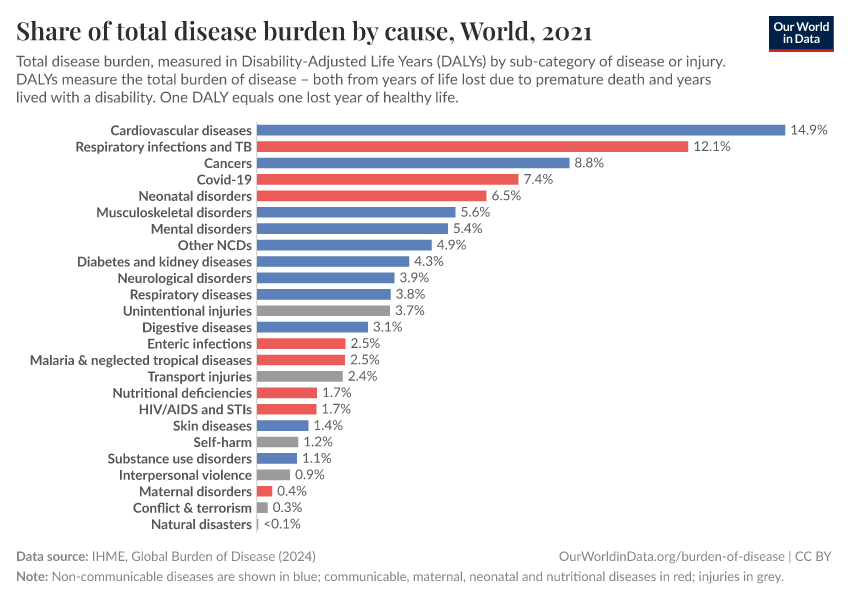
DALYs combine years of life lost to early death with years lived with disability; one DALY represents one lost year of healthy life. That is why musculoskeletal disorders register in the burden at all: people rarely die of them, but they can live with pain, stiffness and impaired movement for decades. After 45, those long-lived limitations become part of the practical health picture even when they do not appear in mortality statistics.
Chapter 06 Where Does Inflammation Fit?
Low grade inflammation can influence bone resorption, cartilage degradation and tendon repair, while laboratory evidence on humic substances offers mechanism rather than a clinical outcome9. For everyday joint comfort, remember that absorption depends on the gut, and other botanicals have separate evidence and limits.
6.1 · Low grade inflammatory loadThe Persistent Background Signal
The background inflammation of midlife is not the redness of an injury. Midlife background inflammation is a modest, persistent elevation that changes how tissue behaves: it favours resorption in bone, degradation in cartilage and interference in tendon repair. Midlife background inflammation is also the thing most likely to respond to how somebody eats, sleeps and moves.
6.2 · Mechanism evidenceUseful Context, Not a Clinical Outcome
Humic substances, the chemical family fulvic acid belongs to, have been reviewed for anti-inflammatory activity across laboratory and animal work9. That review is a mechanism paper rather than a clinical one, and it should be read that way: an explanation of why the human markers moved, not independent evidence that they did.
6.3 · Evidence boundariesWhat Each Study Can Support

| Evidence | What it measured | What it supports | What it does not |
|---|---|---|---|
| bone trial over 48 weeks | Density and turnover markers | Slower loss in postmenopausal women | Rebuilding lost bone 4 |
| collagen study over eight weeks | Serum synthesis marker | More type I collagen being made | A repaired tendon or joint 5 |
| Strength protocol | Force retained under fatigue | Better tolerance of hard effort 6 | Treating any joint condition |
| Muscle transcriptome | Matrix gene expression | A more active repair environment | Structural change you can feel |
| Humic substance review | Laboratory inflammation models | A plausible mechanism | Clinical benefit on its own |
Chapter 07 How Would a Sensible Person Actually Use This?
A sensible trial may use a purified, standardised form consistently, follow the evidence window, and keep exercise, protein, vitamin D and sleep in place. Start with how to take it, then choose the resin itself, start small, or consider a six-month course while balancing load and recovery.
7.1 · Start with the evidence windowThink in Weeks and Months
Human trials have generally used purified, standardised extract in the range of 250 to 1000 mg daily, with the lower-dose bone work running for 48 weeks4 5. The pattern that may matter is duration rather than dose: every outcome above was measured over weeks to months, not days.
7.2 · Choose the sustainable formRoutine Matters More Than Format
Form is a matter of routine rather than superiority. Resin is the traditional preparation and dissolves in warm water. Capsules and tablets give precise dosing and travel well. The best form is the one that still gets taken in week ten, because that is when the measurements above were made.

Practical check What Should You Verify Before Taking Shilajit?
Verify the batch before considering the outcome. A defensible product publishes its heavy metal panel, states the tested fulvic acid result, documents DBPs without an unsupported percentage, and identifies its source. Personal safety comes next: medication, pregnancy, breastfeeding and iron overload all warrant a conversation with a clinician before use.
Verified product facts
7.3 · Verification and safetyCheck the Assay Before the Claim
Two cautions are worth stating plainly. Raw material scraped from rock can carry heavy metals, so purification and third party testing are not marketing decoration3. Anyone with iron overload conditions, anyone pregnant or breastfeeding, and anyone on anticoagulants, diabetes or thyroid medication should talk to their doctor first rather than experiment.
- Duration over dose. 12 weeks before judging anything, taken with food.
- Third party testing. Ask for the heavy metal panel, not just the fulvic percentage.
- Keep the basics. Load bearing exercise, protein and vitamin D do the structural work.
What Our Customers Say
FAQ Questions About Joint and Bone Support After 45
Scientific Bibliography
PubMed-indexed · tap any source to open
- PubMed record · 2016Dietary magnesium intake, bone mineral density and risk of fracture: a systematic review and meta-analysis.PMID 26556742
- PubMed record · 2022Impact of magnesium on bone health in older adults: A systematic review and meta-analysis.PMID 34666201
- PubMed record · 2024Hazardous or Advantageous: Uncovering the Roles of Heavy Metals and Humic Substances in Shilajit (Phyto-mineral) with Emphasis on Heavy Metals Toxicity and Their Detoxification Mechanisms.PMID 38393486
- PubMed record · 2022Shilajit extract reduces oxidative stress, inflammation, and bone loss to dose-dependently preserve bone mineral density in postmenopausal women with osteopenia: A randomized, double-blind, placebo-controlled trial.PMID 35933897
- PubMed record · 2024Effects of eight weeks of Shilajit supplementation on serum Pro-c1α1, a biomarker of type I collagen synthesis: a randomized control trial.PMID 36546868
- PubMed record · 2019The effects of Shilajit supplementation on fatigue-induced decreases in muscular strength and serum hydroxyproline levels.PMID 30728074
- PubMed record · 2016The Human Skeletal Muscle Transcriptome in Response to Oral Shilajit Supplementation.PMID 27414521
- PubMed record · 2019Skin Transcriptome of Middle-Aged Women Supplemented With Natural Herbo-mineral Shilajit Shows Induction of Microvascular and Extracellular Matrix Mechanisms.PMID 31161927
- PubMed record · 2015The Antiinflammatory Properties of Humic Substances: A Mini Review.PMID 25732236
- Additional verified source · 2015A critical appraisal on the association and effects of magnesium and bone density on physical performance in elderly women.PMID 25833985
Medically reviewed by Dr. Nurten Abaci Kaplan, PhD. Dr. Nurten Abaci Kaplan is an independent consultant compensated by Natural Shilajit™ for editorial review. Compensation is not tied to sales, and reviewers do not write our marketing copy. See our reviewers at https://naturalshilajit.com/pages/medical-reviewers. Written by the Natural Shilajit™ Research Team. See also our verified customer reviews.
This article is provided for educational purposes and summarises published research. These statements have not been evaluated by the Food and Drug Administration. This product is not intended to diagnose, treat, cure, or prevent any disease. This article is not medical advice.