Medically reviewed byVictoria WardMedical Herbalist BSc, Certified Ayurvedic Therapist, Former NHS NurseSpecialty: herbal supplements, minerals and bioavailabilityRelationship: medical reviewer for Natural Shilajit™THE PROOF · SHILAJIT BENEFITS
Shilajit Benefits: What It Actually Does for Your Body
What human trials say about shilajit benefits, side effects, formats, taste, safety, and product quality, without the usual hype.
- 10+Years of research
- 200,000+Customers worldwide
- 5Peer-reviewed sources
- EurofinsIndependently lab tested
- WardMedically reviewed
- 2026-08-06Last updated

TL;DR: Shilajit Benefits: What It Actually Does for Your Body
- Human evidence is promising but narrow: androgen markers, fatigue-related strength, bone density, and a collagen biomarker were studied in different groups.1532
- In active young men, 500 mg per day for 8 weeks narrowed post-fatigue strength decline in the stronger half of the cohort.5
- Sex and age change what the evidence means: the testosterone trial enrolled middle-aged men, while the bone trial enrolled postmenopausal women.13
- No verified trial here compared resin, gummies, capsules, or honey sticks head to head.1532
- Purity is a documentation question: look for source records, contaminant screening, a batch-level CoA, and DBP verification.

Contents
- What Is Shilajit Good For, and What Does Shilajit Do for Your Body?
- What Are the Benefits of Shilajit According to Human Research?
- What Does Shilajit Help With for Energy, Strength, Bones, and Skin?
- What Are Shilajit Resin Benefits Compared With Gummies and Capsules?
- Is Shilajit for Men or Women, and Do the Benefits Differ by Sex?
- Is Shilajit Safe, and What Shilajit Side Effects Should You Know?
- What Does Shilajit Taste Like, and How Do You Choose a Pure Form?
Chapter 01What Is Shilajit Good For, and What Does Shilajit Do for Your Body?
Shilajit isn't a universal fix. Human trials have measured testosterone in healthy middle-aged men1, fatigue-related strength in active young men5, bone density in postmenopausal women with osteopenia3, and a collagen-synthesis biomarker in trained young men.2 Each result belongs to its study population and preparation.
Vague benefit lists drain trust, sabotage decisions, and blur which outcomes human trials actually measured.
Shilajit is a natural, mineral-rich resin-like exudate formed in mountain rock fissures over long periods. The material contains humic substances, fulvic compounds, minerals, and dibenzo-alpha-pyrones, or DBPs. A deeper molecular guide to authentic shilajit explains why chemistry and purification matter more than folklore.4
RecognitionWhat can drain trust, and what can restore it?
A broad phrase such as shilajit health benefits hides four separate questions: who took the material, which preparation they took, what dose they used, and what outcome researchers measured. Readers dealing with an afternoon crash can compare the evidence with the wider causes of persistent tiredness without turning one supplement into an answer for every cause.
Evidence filterWhich details protect context and rebuild confidence?

The Altai source question and the science of fulvic compounds and nutrient absorption are useful background. But an outcome is only useful when the trial population matches your body.
Chapter 02What Are the Benefits of Shilajit According to Human Research?
Human research provides four narrow signals. Purified shilajit changed androgen markers after 90 days in healthy men aged 45 to 551. Separate trials measured fatigue-related strength after 8 weeks5, bone density through 48 weeks in postmenopausal women3, and serum pro-c1a1 after 8 weeks in trained men.2
Marketing compresses four small studies into one giant promise, raising risk and blocking sound judgment.
Population matching protects the reader and rebuilds trust. A focused testosterone evidence review keeps the all-male result inside its proper boundary.
StrengthWhat did the fatigue trial actually find?
The muscular result came from 63 recreationally active men. Participants used 250 mg per day, 500 mg per day, or placebo for 8 weeks. In the stronger half of the cohort, post-fatigue strength decline averaged 8.9% with 500 mg, versus 17.0% with 250 mg and 16.0% with placebo.5
- Subgroup warning: an upper-half result doesn't describe every participant or every starting strength level.
- The 250 mg group did not differ significantly from placebo for that outcome.5
- Baseline hydroxyproline measured 1.5 micrograms per milliliter in the high-dose subgroup versus 2.4 in both comparison groups.5
CollagenWhy can a biomarker rebuild context but not prove skin change?
A trial of 35 recreationally trained men compared 500 mg and 1,000 mg per day with placebo for 8 weeks. Serum pro-c1a1 increased in both shilajit groups, while 75% of the high-dose group exceeded the prespecified meaningful-change threshold versus 30% with placebo.2
Eight weeks of Shilajit supplementation with 500 and 1000 mg per day increased type 1 collagen synthesis.2Neltner and colleagues, Journal of Dietary Supplements

The bone and joint evidence, the collagen and skin evidence, and the DBP energy pathway answer different questions. Product verification belongs in our Eurofins lab results; clinical outcomes belong in the cited trials. But muscle and collagen are only two parts of the benefit story.
What Our Customers Say
Morning cup of rocks
I love Shilajit. I've been drinking it in some hot water every morning for a couple months now and I feel really good. My headaches don't come as often as they used to and I feel more energetic. My mood overall has gotten much better too. The taste is interesting... tastes like rocks in hot water. I call it my morning cup of rocks. Delicious.
Gianna Kasparek, Mar 24, 2021
Ancient essentil supplement
Shilajit is so essential to get all the nutrients you really want. I take it sublingually. The taste is an acquired one and takes some getting used to but you can easily take it knowing how good it is for you. Awesome product
Max, Apr 2, 2019
Extremely bitter
The product looks exactly as shown. It is very thick and bitter. I cannot tell a difference in my energy levels and I have been using the product since May 7. At this time, I do not know if I will purchase the product again, but I think if anyone is considering this purchase to please do so. The directions state it should be melted in hot water and even then it is very hard to dissolve. My tea was cool by the time the product dissolved. I used honey to counteract the bitterness and now I have become so accustomed to the taste that I could probably do without the honey. I actually like it.
Melanie Johnson, Jun 2, 2021
Chapter 03What Does Shilajit Help With for Energy, Strength, Bones, and Skin?
Direct human evidence is strongest for fatigue-related strength retention5, bone-density preservation in a specific female cohort3, and a collagen-synthesis biomarker in trained men.2 The verified trials supplied here didn't measure everyday energy, brain fog, sleep, or visible skin change, so those popular benefits remain separate questions.
Broad benefit labels deplete context, crash expectations, and hide the difference between a mechanism and a measured outcome.
A biomarker and a felt result are different evidence categories. The cellular energy background keeps those ideas separate.
Energy and strengthWhich result can protect evidence from a stimulant story?
The strength trial tested fatigue, not a daily energy rating. After 8 weeks, 500 mg per day narrowed the decline in maximal voluntary isometric contraction within the stronger half of 63 active young men. The trial didn't measure caffeine use, afternoon focus, or sleep.5
Bones and skinWhich findings rebuild the claim without inflating it?
Sixty postmenopausal women aged 45 to 65 with osteopenia used placebo, 250 mg, or 500 mg daily for 48 weeks. Bone density at the lumbar spine and femoral neck was better preserved at weeks 24 and 48 in both shilajit groups. The study belongs in a midlife bone-health conversation, not a universal bone promise.3
The collagen trial measured serum pro-c1a1 in trained men, with increases after 8 weeks at 500 mg and 1,000 mg per day. Type 1 collagen matters to skin and connective tissues, but the trial didn't score wrinkles, elasticity, hydration, or appearance. The evidence fits beside a broader skin-health guide, with the biomarker boundary intact.2
- Mechanism stays separate
- No caffeine outcome
- Isometric contraction
- Active young men
- Lumbar spine
- Femoral neck
- Serum pro-c1a1
- No appearance score
- Check the outcome: maximal strength after fatigue belonged to the 8-week performance trial.5
- Check the population: bone density belonged to 60 postmenopausal women with osteopenia.3
- Check the proxy: pro-c1a1 was a blood biomarker, not a skin photograph or clinical skin score.2
- Check the missing endpoint: the supplied trials didn't measure sleep or everyday focus.

The sleep and mitochondrial guide separates pathways from outcomes. But format changes create a new evidence problem.
Chapter 04What Are Shilajit Resin Benefits Compared With Gummies and Capsules?
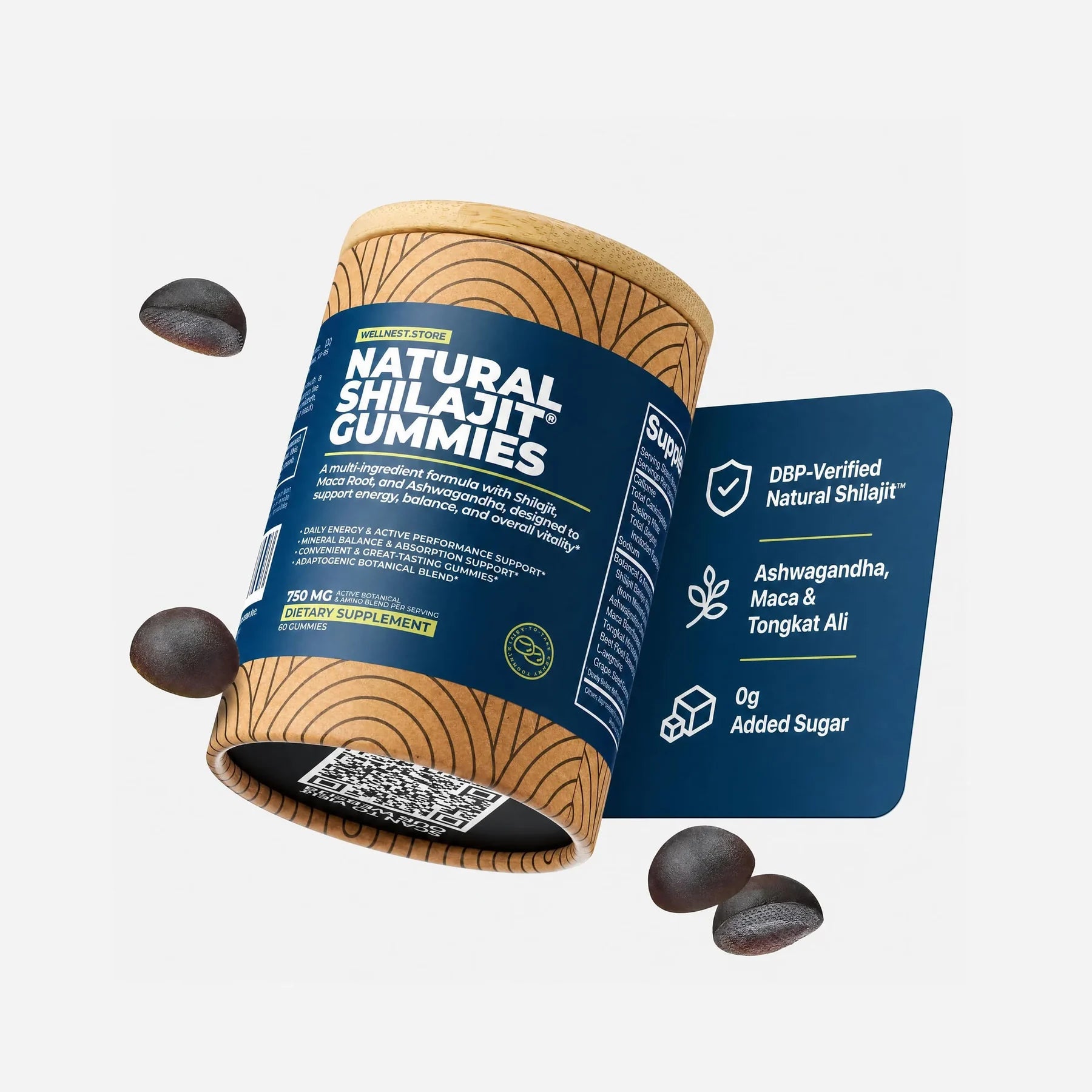
Resin, gummies, capsules, and honey sticks differ mainly in texture, taste, ingredients, and convenience. No verified trial in this evidence set compared finished formats head to head, so shilajit resin benefits can't be ranked above shilajit gummies benefits, shilajit capsule benefits, or shilajit honey sticks benefits.
Every Natural Shilajit format shares the same sourcing and batch testing. What actually varies in this market is whether that gets disclosed.
| Factor | Natural Shilajit™ (any format) | Typical Market Shilajit |
|---|---|---|
| Source | Single-source Altai Mountains resin, traceable per batch | Origin frequently undisclosed or unverifiable |
| Lab verification | Batch-level Certificate of Analysis published for every lot | Third-party lab testing rarely disclosed to buyers |
| Contaminant screening | Screened for heavy metals and contaminants each batch | Contaminant screening not a standard practice |
| Label accuracy | Ingredient list matches published lab assay | Label claims not independently confirmed |
| Format options | Resin, gummies, capsules, tablets, or honey - same verified Altai material | Verification, if any, is usually format-specific and undisclosed |
Format hype adds cost, blocks fair comparison, and can sabotage a choice that should stay practical.
ChoiceWhat can protect convenience without sabotaging evidence?
Different formats suit different routines. Resin offers the traditional texture and taste. Capsules avoid taste. Gummies simplify use. Honey sticks pair resin with honey. The practical guide to resin, capsules, and NutriHoney focuses on handling and routine rather than declaring one format superior.
- Resin choice: weigh earthy taste, warm-water preparation, serving control, and batch testing.
- Gummy choice: inspect sweeteners, added ingredients, shilajit quantity, and finished-product testing.
- Capsule choice: inspect the actual ingredient, capsule material, serving size, and contaminant report.
- Honey-stick choice: weigh portability, taste, honey content, and transparent resin sourcing.
Evidence transferWhy can format hype add cost and block a fair comparison?
The testosterone, strength, bone, and collagen trials each used a defined shilajit preparation. None tested a retail-format contest. Finished products need direct evidence before a resin, gummy, capsule, or honey-stick outcome can be ranked.
A form-first check protects choice and replenishes clarity. But the same evidence also changes meaning across male and female study populations.
Chapter 05Is Shilajit for Men or Women, and Do the Benefits Differ by Sex?
Sex doesn't make shilajit exclusive, but sex changes what the measured evidence can answer. Testosterone was studied in healthy men aged 45 to 551. Strength and collagen trials enrolled younger men52. Bone-density evidence comes from postmenopausal women aged 45 to 65 with osteopenia.3
Cross-sex claims drain precision, raise risk, and turn one narrow cohort into a promise for everyone.
Study population and measured outcome are separate labels in an evidence summary. The dedicated guides to shilajit for women and natural testosterone research should begin with the same rule.
MenWhat can men carry forward without overreaching?
The androgen result belongs to healthy middle-aged men. Participants aged 45 to 55 used 250 mg twice daily for 90 days, with increases in total testosterone, free testosterone, and DHEAS versus placebo. The trial doesn't establish the same outcome in younger men, women, or people with a known hormone condition.1
The strength trial enrolled 63 recreationally active men with a mean age near 215, while the collagen trial enrolled 35 trained men with a similar mean age.2 The men's health research guide should keep those younger performance cohorts separate from the middle-aged androgen cohort.
WomenWhat can women use to protect context and rebuild trust?
The female evidence comes from 60 postmenopausal women aged 45 to 65 with osteopenia. Daily 250 mg and 500 mg doses were studied for 48 weeks, with bone density measured at the lumbar spine and femoral neck. The trial didn't measure fertility, menstrual symptoms, libido, or skin appearance.3
- Male androgen claims belong to men aged 45 to 55 in the 90-day trial.
- Male strength claims belong to active young men after a laboratory fatigue protocol.
- Male collagen claims belong to trained young men and a serum biomarker.
- Female bone claims belong to postmenopausal women with osteopenia.
A separate hair evidence guide can address appearance questions without borrowing male-only endpoints. But demographic fit is only useful when safety screening comes first.
From this article's own data
What This Trial's Own Numbers Show
Source: PubMed 30728074. Peer-reviewed clinical trial cited in this article.
Post-fatigue strength decline after 8 weeks
This is the article's own cited trial, not an outside dataset - the same strength result discussed earlier in the text, charted directly so the comparison is visible, not just stated. A wellness claim is only as strong as the specific number behind it.
Chapter 06Is Shilajit Safe, and What Shilajit Side Effects Should You Know?
Shilajit safety depends on purification, dose, health status, and medication use. The four human trials supplied here studied narrow adult groups and specific preparations; pregnancy, breastfeeding, children under 12, hemochromatosis, gout, and major drug combinations were not represented, so personal clinical clearance matters before use.
Ignoring exclusions raises risk and can sabotage a routine before side effects have a clear explanation.
Clinician review protects decisions and replenishes context. Dietary supplements don't receive FDA premarket approval for health claims. Always consult your healthcare provider before starting, especially with a condition or prescription medication.
ContraindicationsWho should pause before starting?
- Pregnant or breastfeeding people and children under 12 should pause because the supplied human trials didn't study those groups.
- People with hemochromatosis or gout should ask a clinician before use.
- People taking blood thinners, diabetes medication, blood-pressure drugs, or immunosuppressants should request an interaction review because these combinations weren't tested in the supplied trials.
- Raw or poorly purified material adds contamination uncertainty, so batch-level screening belongs in the safety decision.
DoseWhat amounts did researchers study?
The performance trial studied 250 mg and 500 mg daily for 8 weeks5. The collagen trial studied 500 mg and 1,000 mg daily for 8 weeks2. The androgen trial used 250 mg twice daily for 90 days1. The bone trial used 250 mg and 500 mg for 48 weeks.3
Study doses aren't a universal serving range. Follow the tested product's label, don't exceed the labeled amount, and ask a clinician when health conditions or medications change the risk profile. The Natural Shilajit lab safety report and medical reviewer profiles add product-level and professional context.
Honest limitsWhat can't shilajit do?
Shilajit can't stand in for sleep, adequate food, training, or a personal medical evaluation. Shilajit can't turn a collagen biomarker into proof of visible skin change2, and shilajit can't turn one male hormone trial into a universal result.1 Strong taste, routine friction, narrow evidence, and contamination risk are trade-offs.
The supplement safety guide explains why natural origin still needs screening. One purity number matters only with its lab record.
Chapter 07What Does Shilajit Taste Like, and How Do You Choose a Pure Form?
Shilajit resin has an earthy, bitter, and mineral-rich flavor profile. Purity is an analytical question, not a taste test. Source records, contaminant screening, a batch-level Certificate of Analysis, and DBP verification form the documentation set. Texture and flavor are sensory observations; laboratory records are analytical evidence.
Marketing mythology adds cost, raises risk, and turns taste into a shortcut for laboratory proof.
Documentation helps you reclaim control and protect the daily ritual. An Altai provenance guide explains origin, while the public Certificate of Analysis page carries the batch-level evidence.
Texture and tasteWhat should real resin feel like?
Real resin is dense, sticky, and responsive to temperature. Cold makes the texture firmer. Warmth makes the texture softer. Warm water disperses the resin into an earthy, bitter drink. Taste can identify a mismatch, but taste can't verify contaminants or molecular authenticity.

VerificationWhich proof points survive the hype?
Proof and Red Flags
Natural Shilajit publishes batch documentation for heavy-metal screening, microbiology, and authenticity. The CoA-tied fulvic result and Eurofins DBP verification answer different questions: fulvic content describes composition, while DBP verification addresses authenticity. The company's sourcing and testing history gives the context behind those records.
- Source record: identify Altai origin and the party responsible for the finished product.
- Batch record: match the product lot with a current Certificate of Analysis.
- Contaminant record: look for heavy-metal, microbiology, and other relevant screening.
- Authenticity record: look for DBP verification without an invented DBP percentage.
Natural Shilajit Resin is the same lab-verified Altai resin this research describes: one small daily serving of the whole mineral story. Natural Shilajit keeps the product bridge simple because proof over hype is the more useful ending.
A pure-form decision should end with documents, not mythology. Missing paperwork doesn't change the taste. Missing paperwork changes what you can know. Five practical questions remain once the marketing is stripped away.
What Our Customers Say
It is lab tested for mineral ingredients and toxins and heavy metals
It is great, it is not so hard to take with a scoop.
Chilmi Ntalli, May 3, 2025
Good project
Good project highly recommended
Dharminder Singh, January 17, 2025
good
When I take shilajit energy level is high
Manpreet Kaur, November 20, 2024
FAQQuestions Readers Ask Most
Scientific Bibliography
PubMed-indexed - tap any source to open
- PubMed recordClinical evaluation of purified Shilajit on testosterone levels in healthy volunteers.2016PMID 26395129
- PubMed recordEffects of 8 Weeks of Shilajit Supplementation on Serum Pro-c1α1, a Biomarker of Type 1 Collagen Synthesis: A Randomized Control Trial.2024PMID 36546868
- PubMed recordShilajit extract reduces oxidative stress, inflammation, and bone loss to dose-dependently preserve bone mineral density in postmenopausal women with osteopenia: A randomized, double-blind, placebo-controlled trial.2022PMID 35933897
- PubMed recordIn vitro evaluation of the antiviral properties of Shilajit and investigation of its mechanisms of action.2015PMID 25792012
- PubMed recordThe effects of Shilajit supplementation on fatigue-induced decreases in muscular strength and serum hydroxyproline levels.2019PMID 30728074
Medically reviewed by Victoria Ward. The reviewer is an independent consultant compensated by Natural Shilajit™ for editorial review. Compensation is not tied to sales, and reviewers do not write our marketing copy. See our reviewers at naturalshilajit.com/pages/medical-reviewers. Written by the Natural Shilajit™ Research Team.
This article is provided for educational purposes and summarises published research. These statements have not been evaluated by the Food and Drug Administration. This product is not intended to diagnose, treat, cure, or prevent any disease. This article is not medical advice.